

Li0terary Classics
The Little Mermaid
The tragic yet beautiful story of The Little Mermaid, penned by the legendary Danish author Hans Christian Andersen and first published in 1837, remains one of the most poignant works in the canon of world literature. Far removed from some modern, softened retellings, Andersen’s original narrative is a profound exploration of unrequited love, the human soul, and the heavy price of transformation.
The story follows a young mermaid who, upon falling in love with a human prince she rescues from a shipwreck, strikes a perilous bargain with a Sea Witch. She trades her voice and her life beneath the waves for human legs, enduring excruciating pain in a desperate quest to win the prince’s love and gain an immortal soul.
Fairy Tales (The Little Sea Maid)
K.T.C.102.a.15
Author: Hans Christian Andersen
Illustrated by: Harry Clarke
1916
Image: From the British Library collection
The cultural significance of The Little Mermaid lies in its universal themes of longing and self-sacrifice. It has served as a bridge between ancient maritime folklore and modern psychological storytelling, influencing countless artistic interpretations over nearly two centuries.
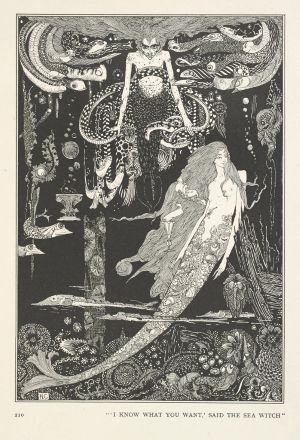
The British Library holds a wealth of historical editions that showcase the story's visual evolution, particularly through the lens of the "Golden Age" of illustration. One of the most striking versions is that of Harry Clarke (1889–1931), a leading figure of the Arts and Crafts Movement. Published in 1916, Clarke’s illustrations are renowned for their Art Nouveau influence, utilizing sinuous lines and delicate coloring to elucidate Andersen’s captivating narrative.
Other notable artistic contributors found within the library’s treasures include Arthur Rackham (1932) and William Heath Robinson (1913), each bringing a distinct visual language to the mermaid’s ethereal world. Rackham’s more whimsical yet detailed style contrasts with the graphic, often haunting precision of Harry Clarke’s black-and-white plates.
These various interpretations highlight the enduring public appetite for the story, which has inspired everything from ballet and theatre to the iconic statue in Copenhagen and major cinematic adaptations like Disney’s global franchise. Andersen’s ability to weave profound existential themes into a "fairy tale" ensures that The Little Mermaid remains a vital subject of study for its exploration of identity and the human condition.
About a bit of art
At the delicate intersection of life's poetry and warmth, we construct an aesthetic bridge - a bit of art, a lifestyle brand that reenchants the mundane through artistic reinvention.
In continuous dialogue with the world's premier museums and galleries, we reinterpret art history's iconic moments through a contemporary lens. Mondrian's geometric harmony now dances upon your coffee cup's edge; Hokusai's great wave transforms into soft drapery on home textiles; Matisse's chromatic brilliance awakens in your journal's pages. From collectible art-objects to immersive exhibitions, we translate museum masterpieces into living design - ensuring art never sleeps in glass cases, but breathes within daily rituals.
With a bit of art, ordinary moments become extraordinary encounters. Every day deserves its masterpiece.
0 comments