

Before the Roman province of Dacia fell. Before the Ottoman frontier was drawn. Before Yves Saint Laurent placed it on a Paris runway — there was the altiță.
It is a shoulder. A rectangle of white linen, no wider than a few inches. And yet what women embroidered there — in dense solar rosettes, river-like streams of floral motifs, and geometric codes passed down through generations — was nothing less than a complete language.

Maria Cristea, holder of the Honorific Title "Meșter Faur," with her disciples at Casa Cristea, MoldovaPhoto: © Varvara Buzilă, 2021 | Source: UNESCO Intangible Cultural Heritagehttps://ich.unesco.org/img/photo/src/15752.jpg
At A Bit of Art (ABOA), we spend our days at the intersection of world-class archives and meaningful everyday objects. And the Moldovan altiță is one of the most extraordinary finds in that archive.
Here is what the blouse actually says, if you know how to read it:
The altiță — the shoulder register — carries solar and celestial motifs. Stars. Rosettes. Hooked crosses. A connection to the cosmos, stitched in silk.
Below it, the încreț holds the earth. Diamonds. Fertility symbols. The smocking that gathered fabric is also the place where land meets sky.
Down the sleeve, the râuri — "rivers" — flow. Scholars of Moldovan folk costume describe them as labyrinths of life: a winding path toward self-discovery, rendered in thread on white linen.
This is not metaphor. This is a documented, living system of meaning — one so significant that UNESCO inscribed the art of the altiță on its Representative List of the Intangible Cultural Heritage of Humanity in 2022.
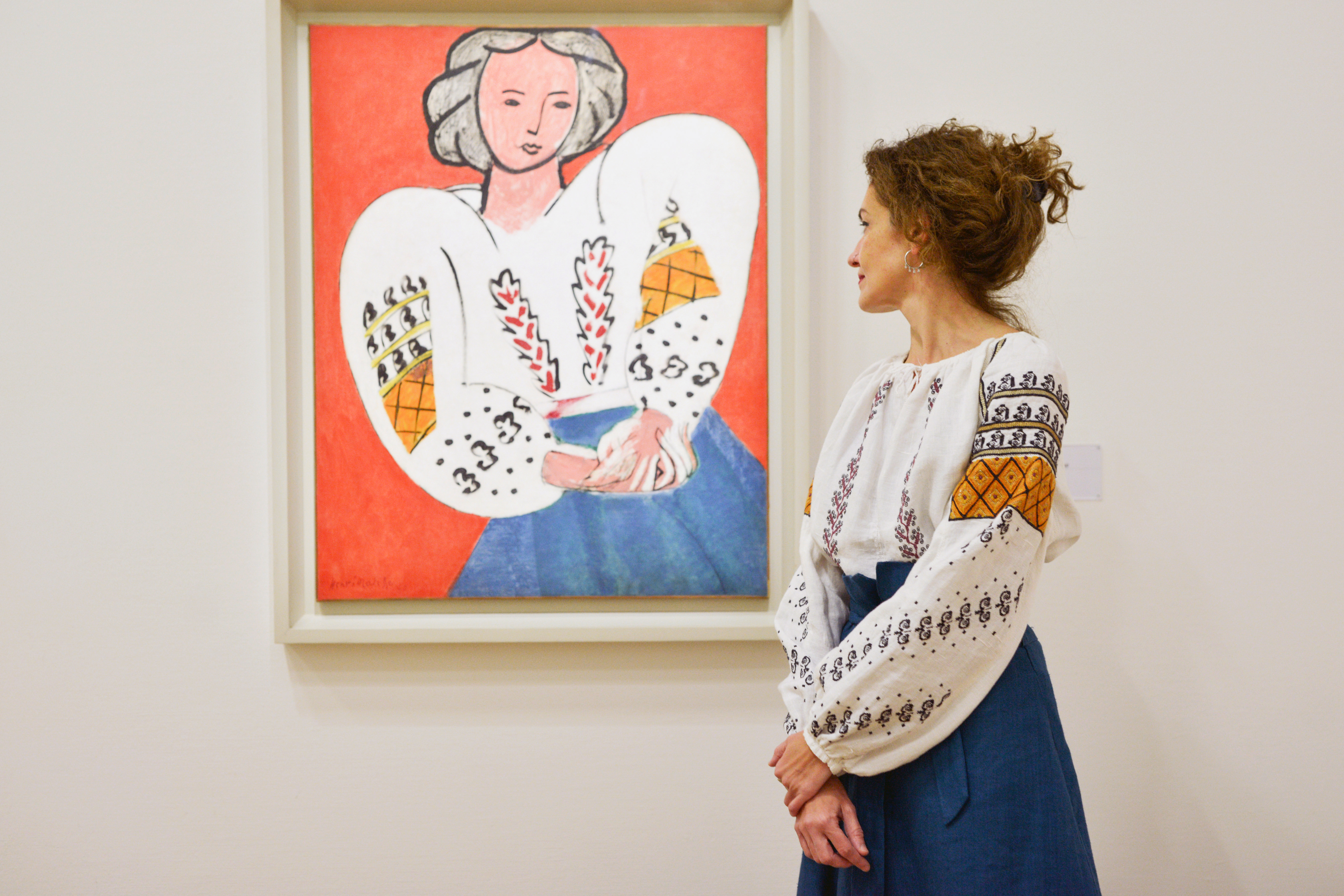
"Talking with Matisse" — a group wearing the altiță at Centre Pompidou, ParisPhoto: Andrea Bordeanu | © Asociația Semne Cusute, 2019 | Source: UNESCO Intangible Cultural Heritagehttps://ich.unesco.org/img/photo/src/15746.jpg
Henri Matisse understood it decades before the institution did. In 1940, he painted "La Blouse Roumaine" — a blouse worn by a Romanian model in his studio. He returned to it again and again. Yves Saint Laurent referenced it in 1981. Jean Paul Gaultier, Tom Ford, Oscar de la Renta followed. The fashion world has borrowed this language repeatedly — and the communities who speak it have begun demanding that the borrowing be acknowledged.
In 2024, Louis Vuitton withdrew a beach collection after Romanian and Moldovan voices identified the altiță motifs in it without credit. Two governments, a UNESCO file, and decades of community activism had built the cultural infrastructure to make that response possible.
At ABOA, this is the story we exist to tell — and to transform into objects that carry it faithfully.
The altiță is not a pattern. It is a cosmos embroidered onto linen. It is the life path of every woman who wore it. It is the Moldovan north's vivid graphic density, and the Moldovan center's refined balance, and the south's quiet prestige.

Women from Cezieni sewing blouses with embroidery on the shoulder (altiță), RomaniaPhoto: © Valeru Ciurea, 2018 | Source: UNESCO Intangible Cultural Heritagehttps://ich.unesco.org/img/photo/src/15745.jpg
When we bring it into a headband, a clutch, a piece of literary fabric — we do not borrow it. We study it, credit it, and carry it forward as it was always meant to be carried: with intention.
If you work in heritage licensing, museum partnerships, or brand collaborations — and you believe that the most powerful objects are the ones with the deepest stories — I would like to connect.
#ABitOfArt #Altiță #CulturalHeritage #ArtLicensing #UNESCOHeritage #MoldovanCraft #IntangibleHeritage