

Pride and Prejudice
Long before it became the gold standard for romantic comedy, Jane Austen's most famous work was a manuscript titled First Impressions, drafted in 1796. The novel was rejected by publishers without a reading, languishing for over a decade until Austen revised it into the masterpiece we know today. Published in 1813 as Pride and Prejudice—a title likely inspired by Fanny Burney’s Cecilia—the story dissects the social fabric of Regency England through the sharp, spirited eyes of Elizabeth Bennet.
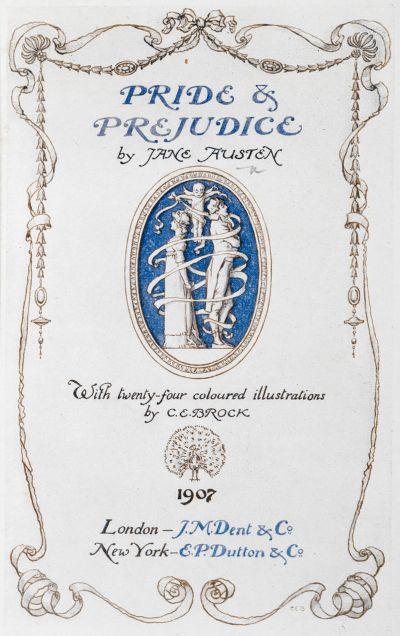
Pride and Prejudice
012208.g.2/3 title page
Author: Jane Austen
Illustrations: Charles Edmund Brock
1907
Image: From the British Library collection
At its core, the novel is a brilliant study of character and class, centered on the friction between Elizabeth's quick judgment and Mr. Darcy's aristocratic reserve. Austen subverts the expectations of her era; the heroine is not saved by a wealthy man but rather saves herself through self-awareness and wit, while the hero must learn that high status does not equate to noble character. The "truth universally acknowledged" that opens the book remains one of literature's most famous lines, instantly setting the satirical tone.
Visually, the novel has been defined by distinct artistic eras. The 1894 "Peacock Edition," illustrated by Hugh Thomson, remains the definitive visual interpretation for collectors. Thomson’s delicate pen-and-ink drawings and the iconic gold-gilded peacock cover captured the grace of the Regency period, solidifying the book's aesthetic as one of elegance and nostalgia. Later, in 1907, C.E. Brock provided another influential visual layer with colour plates that emphasized the domestic warmth and costume detail of the Bennet household, shaping how future generations would envision the world of Longbourn.
About a bit of art
At the delicate intersection of life's poetry and warmth, we construct an aesthetic bridge - a bit of art, a lifestyle brand that reenchants the mundane through artistic reinvention.
In continuous dialogue with the world's premier museums and galleries, we reinterpret art history's iconic moments through a contemporary lens. Mondrian's geometric harmony now dances upon your coffee cup's edge; Hokusai's great wave transforms into soft drapery on home textiles; Matisse's chromatic brilliance awakens in your journal's pages. From collectible art-objects to immersive exhibitions, we translate museum masterpieces into living design - ensuring art never sleeps in glass cases, but breathes within daily rituals.
With a bit of art, ordinary moments become extraordinary encounters. Every day deserves its masterpiece.
0 comments